Appendix_EventLoop
Appendix_EventLoop
Event Loop
import asyncio


loop = asyncio.get_event_loop()


def normal_fn():
    print(f"Here is normal function")


async def async_fn():
    print(f"Here is async function")


# loop.run_until_complete(normal_fn) # This will be throw exception
loop.run_until_complete(async_fn()) # This will be throw exception


print(loop)
Best Practice
asyncio.run(my_async_fn())Diagram
┌───────────────────────────────┐
│        Python Program         │
└───────────────────────────────┘
                 │
                 ▼
      ┌───────────────────────┐
      │   Main OS Thread      │
      └───────────────────────┘
                 │
   ┌─────────────┼───────────────────────────┐
   │             │                           │
   ▼             ▼                           ▼
Loop A       Loop B                      Loop C
(new_event_loop)  (new_event_loop)       (new_event_loop)
 ┌───────┐      ┌───────┐                ┌───────┐
 │ Idle  │      │ Idle  │                │ Idle  │
 └───────┘      └───────┘                └───────┘
   ▲
   │
   │    Only ONE loop can be RUNNING
   │    in this thread at a time:
   │
   ▼
┌─────────────────────────────────────────┐
│      Running Event Loop (e.g., A)       │
│  - Executes async tasks                 │
│  - Handles timers / sockets             │
│  - Manages await points                 │
└─────────────────────────────────────────┘
Threads and Even loop
┌────────────────────┐
│     Main Thread    │
└────────────────────┘
          │
          ▼
   Event Loop A
   (running or idle)


┌────────────────────┐
│   Worker Thread 1  │
└────────────────────┘
          │
          ▼
   Event Loop B
   (running or idle)
Important asyncio rules
Rule 1 — One running event loop per thread Each thread may have one running event loop.
Rule 2 — Event loop is NOT shared between threads If you try to use a loop created in Thread A while in Thread B → RuntimeError.
Rule 3 — Threads communicate via thread-safe asyncio functions
loop.call_soon_threadsafe(callback, arg)Examples:
import threading
import asyncio

def thread_worker():
    loop = asyncio.new_event_loop()
    asyncio.set_event_loop(loop)

    async def run():
        print("Hello from worker loop in thread:", threading.current_thread().name)

    loop.run_until_complete(run())
    loop.close()


from datetime import datetime
def thread_run_forever():
    loop = asyncio.new_event_loop()
    asyncio.set_event_loop(loop)

    async def _run_forever():
        while True:
            await asyncio.sleep(1)

            print(f"Tick: {datetime.now()}")

    loop.create_task(_run_forever())
    loop.run_forever()


# Main thread
main_loop = asyncio.new_event_loop()
asyncio.set_event_loop(main_loop)

# Spawn worker thread
t = threading.Thread(target=thread_worker)
t.start()

async def main():
    print("Hello from main loop in thread:", threading.current_thread().name)

main_loop.run_until_complete(main())
main_loop.close()
t.join()


# Run thread forever ?
t_run_forever = threading.Thread(target=thread_run_forever)
t_run_forever.start()
t_run_forever.join()
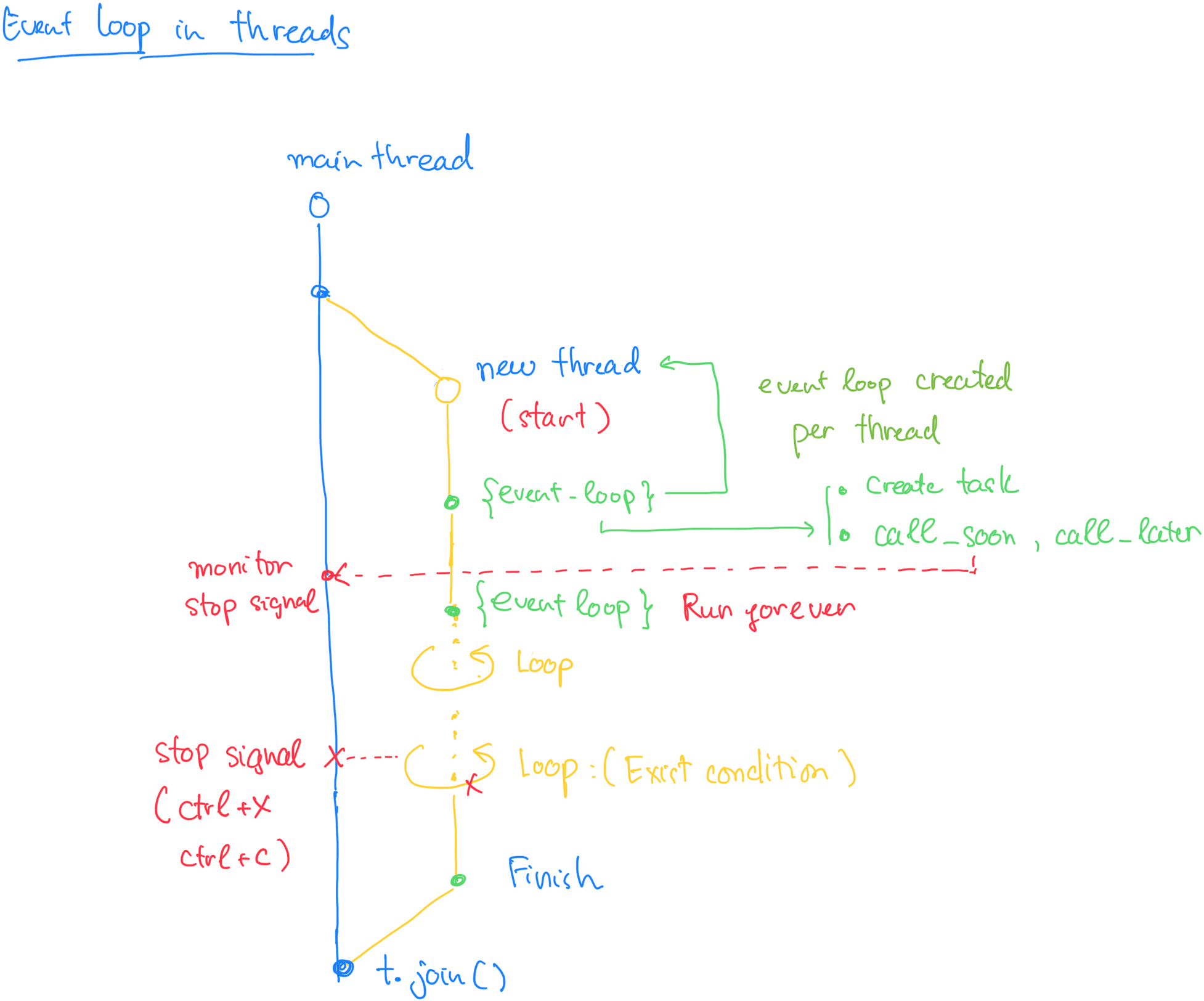
Implement signal stop
import threading
import asyncio
import signal
import time

stop_event = threading.Event()  # Event to signal thread stop

def thread_worker():
    loop = asyncio.new_event_loop()
    asyncio.set_event_loop(loop)

    async def periodic():
        while not stop_event.is_set():  # keep running until stop_event is set
            print("Tick from worker thread")
            await asyncio.sleep(1)


    # Stop loop when stop_event is set
    def check_stop():
        if stop_event.is_set():
            loop.stop()
        else:
            loop.call_later(0.1, check_stop)  # check again after 0.1s
            # pass


    loop.call_soon(check_stop)
    loop.create_task(periodic())


    loop.run_forever()
    # loop.run_until_complete(periodic())


    loop.close()
    print("Worker thread stopped.")

# Start worker thread
t = threading.Thread(target=thread_worker, name="worker")
t.start()

# Signal handler (Ctrl+C sends SIGINT; terminals do not send Ctrl+X as a signal)
def signal_handler(sig, frame):
    if sig == signal.SIGINT:
        print("\nCtrl+C pressed, stopping...")
    elif sig == signal.SIGTERM:
        print("\nSIGTERM received, stopping...")
    stop_event.set()

signal.signal(signal.SIGINT, signal_handler)
signal.signal(signal.SIGTERM, signal_handler)

# Keep main thread alive without busy-waiting
try:
    # Wait until stop_event is set by a signal
    while not stop_event.wait(0.1):
        pass
except KeyboardInterrupt:
    # Fallback: in case default KeyboardInterrupt is raised
    stop_event.set()

t.join()
print("Main thread exiting.")
- I use
call_soon,call_laterto callcheck_stopwhich monitor thestop_signalevent in global scope - In
check_stopfunction, we can continue register a function can be executed in theloop. By logical, it register its self to keep continue checking signal for every0.1seconds - We can have other way to implement without using
call_soon,call_laterby register other task which have a loop to monitorstop_signal
# ... In the `thread_worker`
async def check_stop_task():
        while not stop_event.is_set():
            await asyncio.sleep(0.1)

        loop.stop()

# Then register this task
loop.create_task(check_stop_task())
Event loop in async
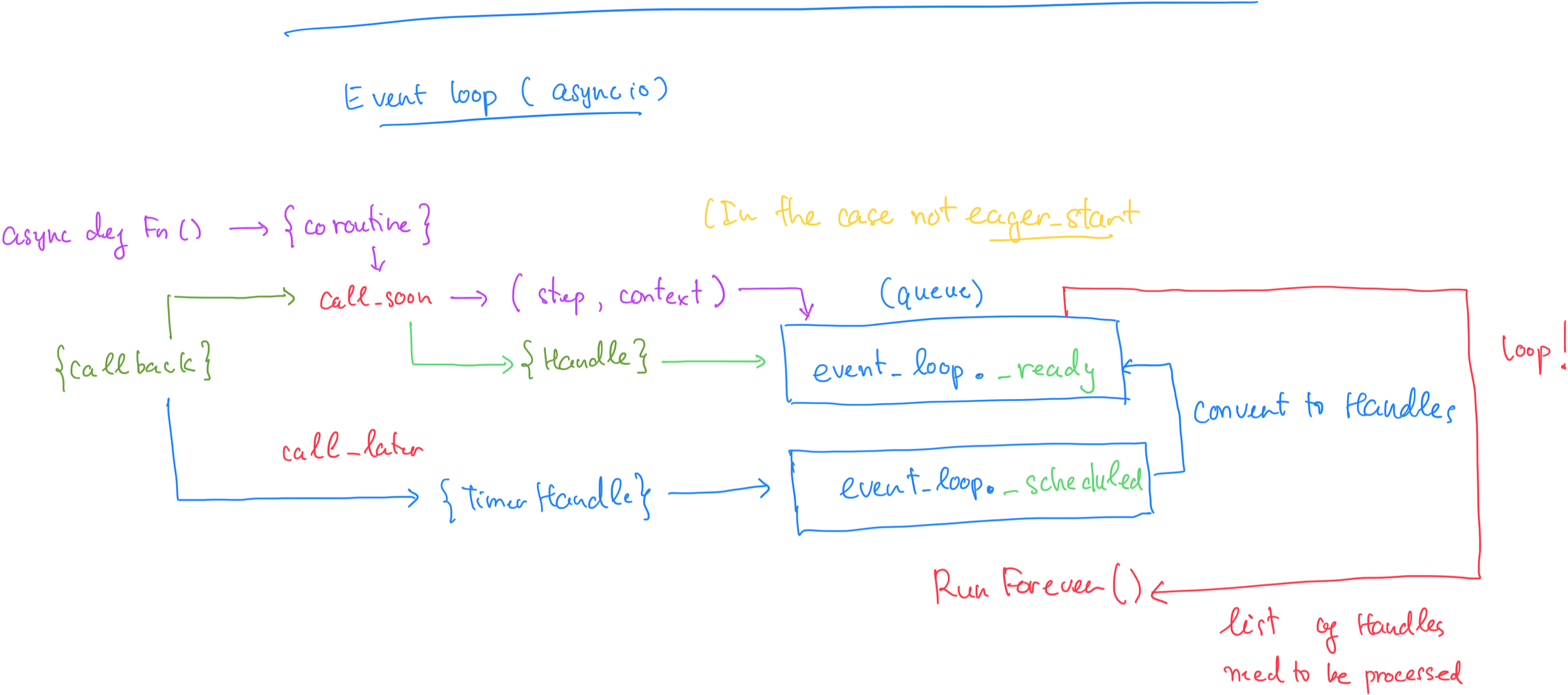
while True:

    # Phase 1 — RUN immediate callbacks
    while loop._ready:
        handle = loop._ready.pop(0)
        handle._run()

    # Phase 2 — WAIT for I/O until next timer
    timeout = compute_timeout_from_scheduled()
    events = selector.select(timeout)

    # Convert I/O events into immediate callbacks
    for event in events:
        loop._ready.append(event.handle)

    # Phase 3 — MOVE expired timers into ready queue
    now = loop.time()
    while loop._scheduled and loop._scheduled[0].when <= now:
        timer = heapq.heappop(loop._scheduled)
        loop._ready.append(timer)